
CAFALAB 2.0 · Calligraphy Fashion Laboratory –
Erasmus+ Blended Intensive Programme
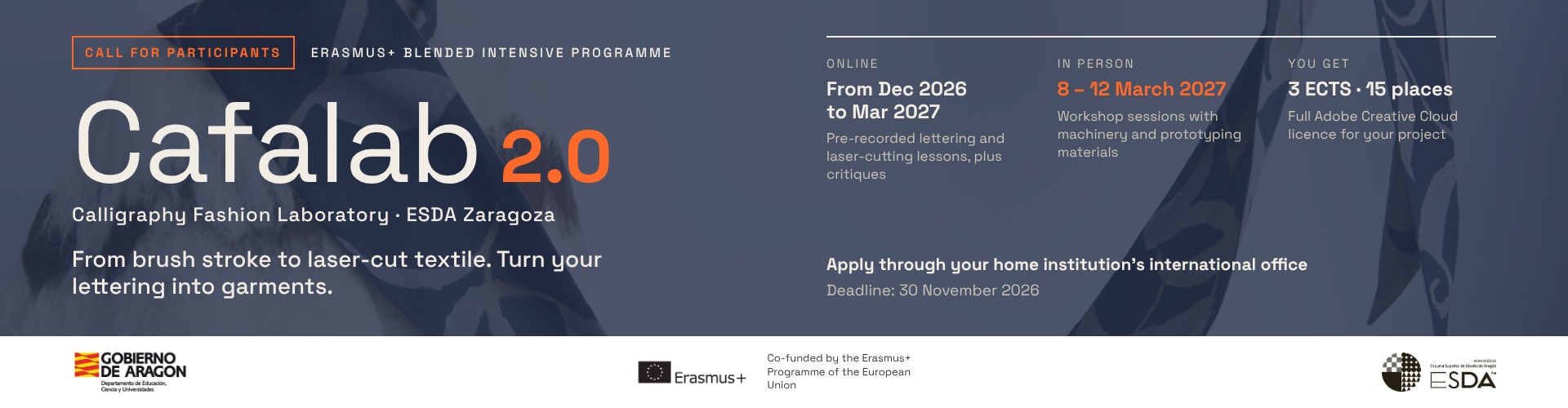
Take a brush stroke. Take it to the machine. Find out what survives of the gesture.
CAFALAB (Calligraphy Fashion Laboratory) is a research laboratory organised by the Escuela Superior de Diseño de Aragón (ESDA) in Zaragoza, Spain. It studies how a hand-drawn letter can travel from paper to a garment and be produced industrially.
In its second edition, CAFALAB 2.0 is looking for 15 students from partner institutions to join an Erasmus+ Blended Intensive Programme that turns brush calligraphy into laser-cut and laser-engraved textiles, with an in-person week at ESDA Zaragoza from 8 to 12 March 2027. In this second edition you will:
- Work with Brush Script: stroke, form and brush texture, and how letter curves behave on fabric.
- Translate your lettering into laser cutting and laser engraving on textiles.
- Start from a set of materials chosen by the team (suede and denim) and then test others. Biomaterials will be tested during the in-person week.
- Produce samples and fill in technical sheets that record each process so it can be repeated.
It is not a calligraphy workshop or a software course: it is a real research project. The technical sheets and sample books you produce will go into an open repository and a scientific publication, with participants credited.
Participants: Students of graphic design, fashion, textile or product design at a CAFALAB partner institution. No previous calligraphy or laser experience is needed, but curiosity about letters and materials is.
Places: 15 participants.
Dates: December 2026 – March 2027
On-site sessions: March 8–12, 2027
Location of on-site sessions: Higher School of Design of Aragon (ESDA). Zaragoza, Spain.
ECTS Recognition: Participation in the programme is accredited with 3 ECTS credits, recognised by your home institution.
Application deadline: November 30, 2026
BIP ID: 2025-1-ES01-KA131-HED-000318577-1
How it works
6
Pre-recorded pieces
All the content on video, with downloadable materials. Watch and rewatch at your own pace while you practise.
4
Individual critiques
Four rounds of one-to-one review of your project with the teaching team, between January and March.
1
Week of workshop
Five days in Zaragoza (8–12 March 2027) with access to machinery, materials and the teaching team.
You arrive in Zaragoza with your project approved and your files ready, so the in-person week is devoted entirely to production. That is why you leave with finished pieces, not just tests.
Application
Places are limited to 15 participants. To apply:
- Complete the application form using the button below.
- Contact the international office at your home institution (which must have a valid agreement with ESDA) and tell them you want to join CAFALAB 2.0.
- Your institution confirms your nomination to ESDA and prepares your Learning Agreement.
You must be able to join the online sessions and travel to Zaragoza for the full in-person week. The online work is part of the programme, not an extra: you are expected to arrive in Zaragoza with your project approved and your files ready.
The deadline for applications is November 30, 2026.
Context
The project combines traditional craftsmanship with modern technological innovations, focusing on calligraphy, letterform design, and digital techniques such as laser cutting and vectorization, applied to fashion and textile experimentation. An interdisciplinary approach and the use of non-traditional media encourage a creative reinterpretation of traditional script models, fostering innovation within type-related design contexts.
The program integrates virtual learning sessions with hands-on in-person workshops, allowing participants to explore concepts independently while receiving expert guidance to refine their projects. This hybrid approach allows participants to develop technical skills and apply them in real-world scenarios, providing valuable insight into industrial processes and production methods. By offering flexible virtual learning options- including group online sessions, individual mentoring, and pre-recorded materials - the programme ensures accessibility for students with diverse learning needs and preferences. The programme's value lies in its interdisciplinary nature, blending graphic and textile design while promoting sustainabl production practices and efficiency. Though primarily designed for students, it also benefits faculty by introducing innovative methodologies that can enhance ESDA's curriculum, fostering creativity in teaching, activities, and future projects. Accessible to both students and faculty, the program encourages collaboration, knowledge exchange, and the integration of new design practices across disciplines.
Program Focus
The program is designed to benefit students by enhancing their academic and creative journey in the fields of fashion, graphic, and product design.Also, the program is focused on Neo-craftsmanshipas the combination of art, craft, and design, emerging as a reaction to unsustainable consumption practices. This approach promotes creative work in collaboration with artisans and the use of modern technologies, where humans play a key role in production, handling tools and techniques that are environmentally friendly.
Objectives
- Translate the gesture into production. Establish a reliable procedure to take a hand-drawn stroke to a machine-produced piece, without losing along the way what made it interesting.
- Measure what is preserved. Determine with data which features of the stroke survive the chain and which do not: outline, modulation, dry-brush endings and texture.
- Build a repertoire of finishes. Use cutting, engraving and marking as a graphic vocabulary, not as three alternative options, and see what each material allows.
- Bring biomaterials into textiles. Formulate sheets in which the stroke is not cut on top but integrated inside, and test whether they withstand garment construction.
- Close the circle with the garment. Place the graphic piece on a real pattern, with its seams and margins, and arrive at a finished garment.
- Publish what we learn. Publish the project’s parameters and technical sheets so that any workshop can reuse them.
What you will learn
Concrete skills, not generic ones. You will practise all of them on your own project.
| Area | What you will be able to do |
|---|---|
| Gesture | Work the brush with intention. Control pressure, load and speed to get the effect you are after: saturated, exhausted, broken or dry strokes. And work in any writing system, even one you invent yourself. |
| Matter | Inks, pigments and substrates. How paper responds, what dilution does, how to provoke an accident and how to make use of it. And which effects then survive the machine. |
| Digitisation | Capture without losing information. Scanning and photography protocol: resolution, light, perpendicularity, scale. The point where most people lose the stroke without noticing. |
| Vector | Vectorise while keeping the detail. Threshold, clean-up, tracing and node control. When auto-tracing is good enough and when you need to retouch by hand. You will work with Adobe software, licence included. |
| Production | Prepare files for the machine. Layers per operation, closed contours, bridges and counters, kerf compensation, export and naming. A file the machine accepts first time. |
| Laser | Cutting, engraving and marking. Power, speed, passes and resolution for each material. And the real limits: the finest stroke that can be cut before the piece falls apart. |
| Biomaterials | Formulate and work your own sheet. Recipes, proportions, curing and shrinkage. Incorporate pigment into the stroke inside the sheet, then take it to cutting and sewing. |
| Patternmaking | Digital patternmaking and placement. Generate your base pattern with MPattern and decide where the graphic piece goes on the actual pattern pieces: seams, margins, zones. |
| Research | Document the way an experiment is documented. Record parameters, results and failures to a publishable standard. It is the skill that will serve you most afterwards, and hardly anyone teaches it. |
Schedule
The programme runs from December 2026 to March 2027, and the hands-on work happens in one in-person week in Zaragoza.
| Phase | When | What happens |
|---|---|---|
| Online phase | December 2026 – March 2027 | Pre-recorded lessons on lettering and laser cutting, step-by-step materials, and one-to-one critique sessions to define your project before you travel |
| In-person week | March 8–12, 2027 | Workshop sessions at ESDA, Zaragoza (Spain), with laser cutting and engraving machinery and materials for prototyping |
| Results | March 15–19, 2027 | The week after the workshop: technical sheets and sample book closed |
Teaching team
The programme is taught by ESDA lecturers from graphic design, fashion and design science.
| Lecturer | Area |
|---|---|
| Dr. Jara Cordero Gómez | Coordination · calligraphy and lettering PhD and lecturer in Graphic Design Projects, and a member of Calligraphy Masters. She leads the project and teaches brush-and-ink experimentation and the transfer of the stroke to vector. |
| Alejandro Conde Herrero | Digital fabrication and laser cutting Head of fabrication. Teaches machine parameters, cutting, engraving and marking, and the real limits of detail of each material. |
| Ana González Collado | Fashion design and prototyping Head of the fashion and textile line. Leads the base garment, patternmaking and the application of the pieces to the garment. |
| Cristina Salvador Muñoz | Scientific foundations of design and materials Leads the formulation and testing of biomaterials: recipes, curing, shrinkage and compatibility with laser cutting. |
| Dr. Zaira Peinado Checa | Digital media Support with vectorisation software and file preparation, and solving technical issues. |
| Saúl Domínguez Albero | Operations manager |
| Andrés Jarabo Moreno | Fashion workshop support (with Ana González Collado) |
| Dr. Javier Marco Rubio | Laser cutting support (with Alejandro Conde Herrero) PhD and specialist in new technologies. Supports the chain from vector to machine, and operates the laser cutter during the in-person workshop. |
| Iván Royo Sanz | Digital media · MPattern expert External collaborator. Creator of MPattern, a platform for automatic pattern drafting and fitting. Teaches digital patternmaking and provides access licences. |
Contact:
Erasmus office, ESDA: erasmus@esda.es
What you get
- 3 ECTS credits, recognised by your home institution.
- A full Adobe Creative Cloud licence (all apps) for your project work.
- Erasmus+ mobility support for the in-person week, managed by your home institution.
- Hands-on training in brush lettering, vector preparation and laser production.
- Your work documented in the CAFALAB repository and credited in the publication of results.
- A certificate of participation from ESDA.
Previous edition: CAFALAB 2025–26
In its first edition, CAFALAB proved that a hand-drawn Gothic letter can become a laser-cut garment in a single week.
23 sessions over six months · 7 partner institutions · 5 days of in-person workshop · 2 guest calligraphers
From stroke to garment. Students moved through the full CAFALAB workflow: hand lettering → vectorisation → laser cutting → application on fabric. Online sessions on the history of Western calligraphy, Word Design (Adam Theosone) and Calligraffiti (Victor Kams) prepared the in-person week at ESDA, 23–27 March 2026.
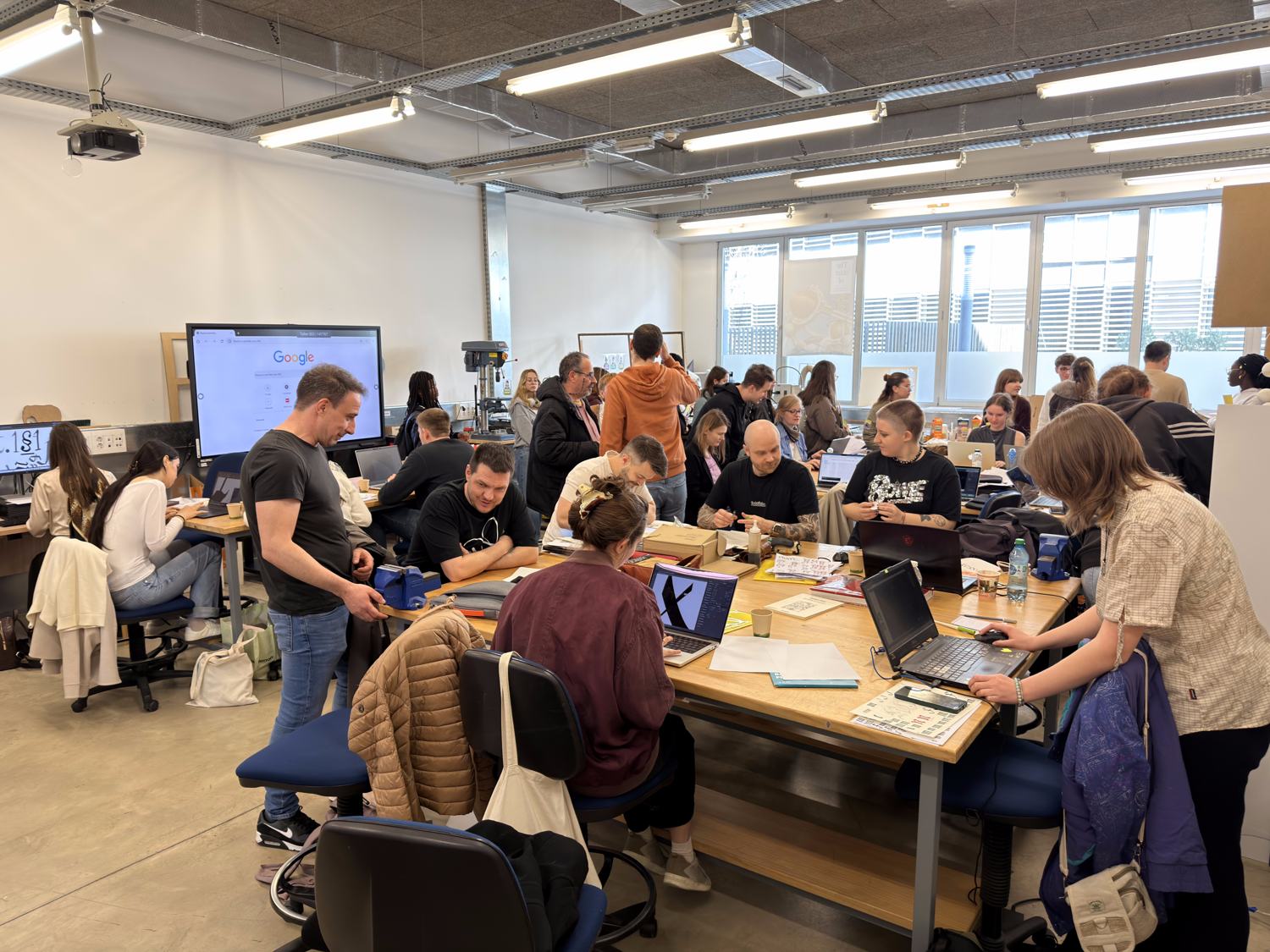
What came out of the workshop:
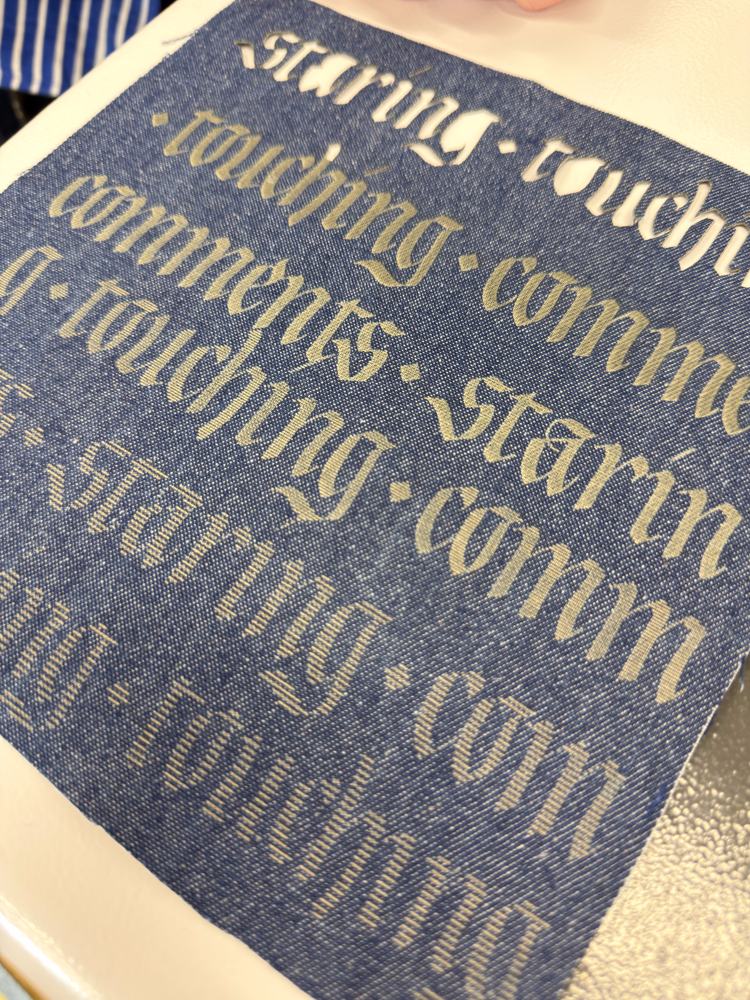
- Gothic lettering laser-cut on denim, repeating «touching · comments · staring».
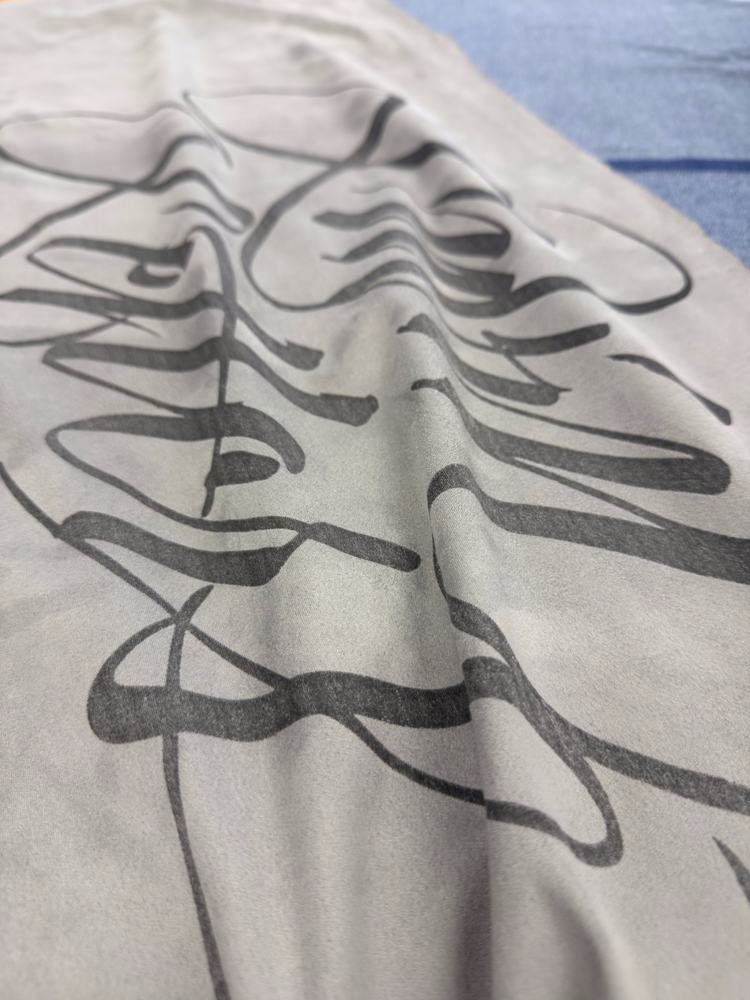
- Large-scale gestural calligraphy on flowing fabric.
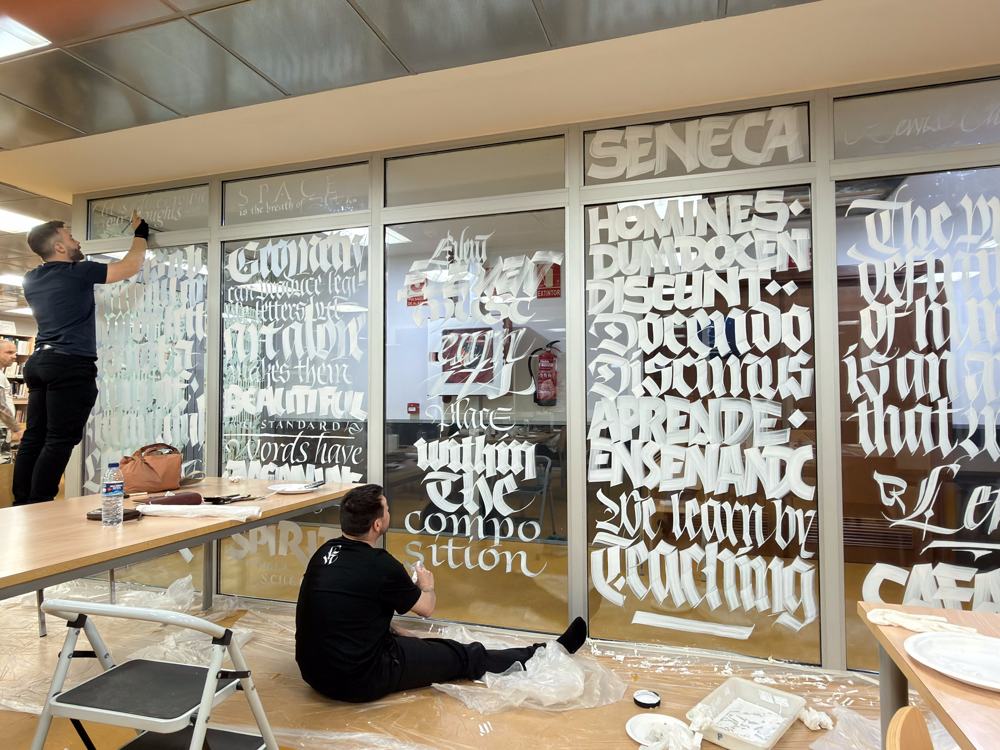
- A floor-to-ceiling curtain of die-cut Gothic letters installed on the school’s glass façade.
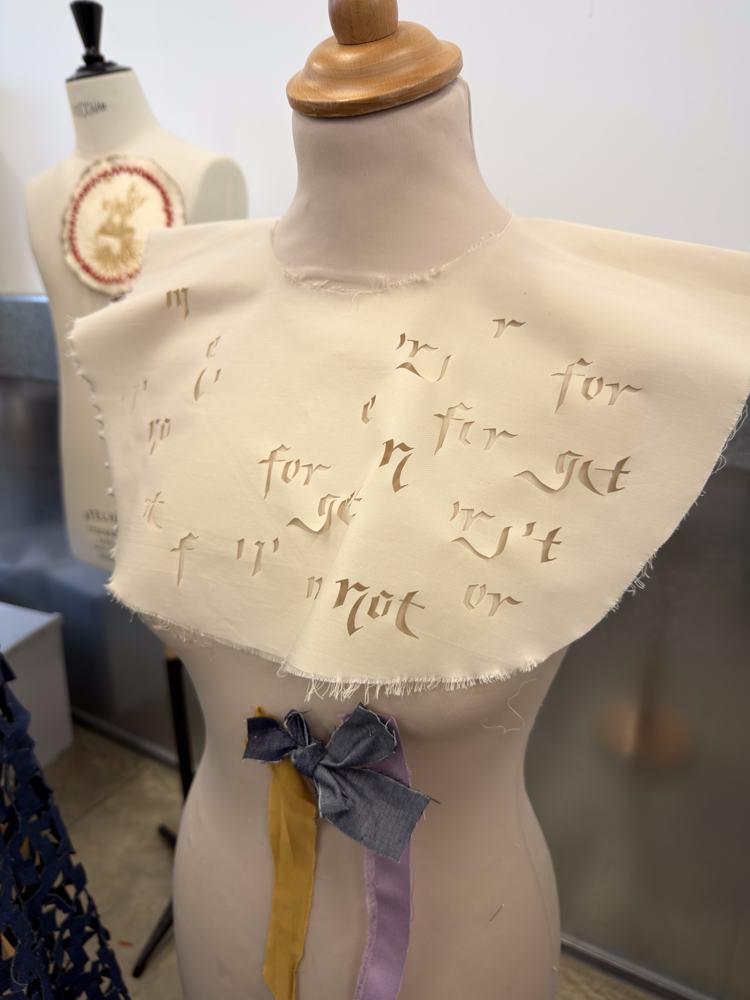
- The final piece: a calligraphic bib with laser-cut Gothic text, «forget · not · for», built into the garment’s structure.
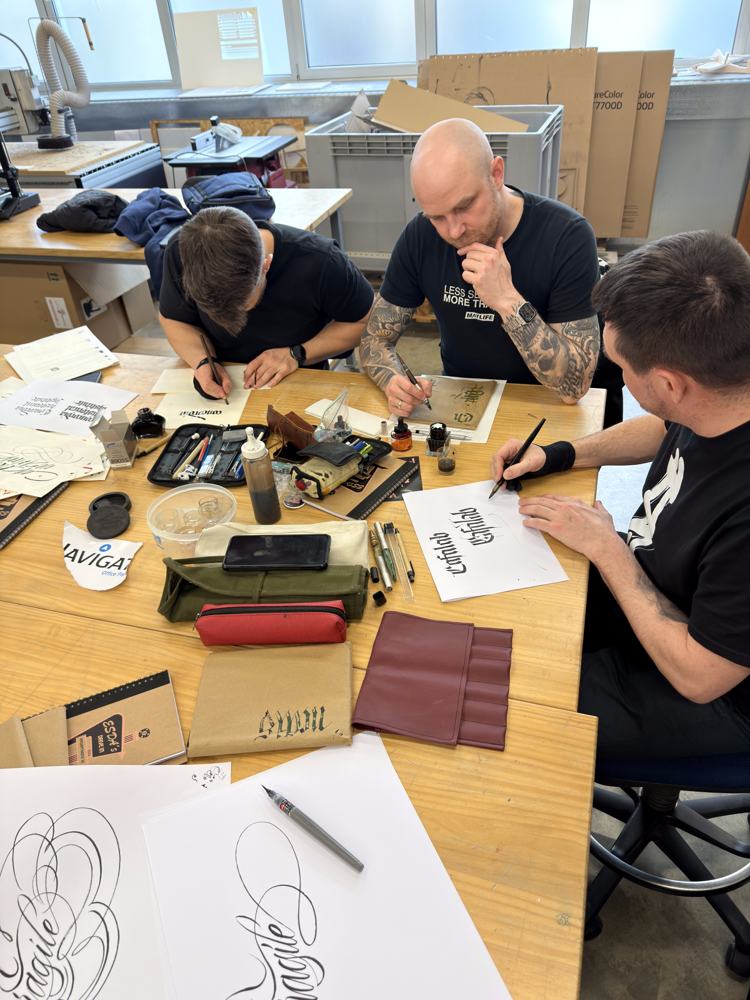
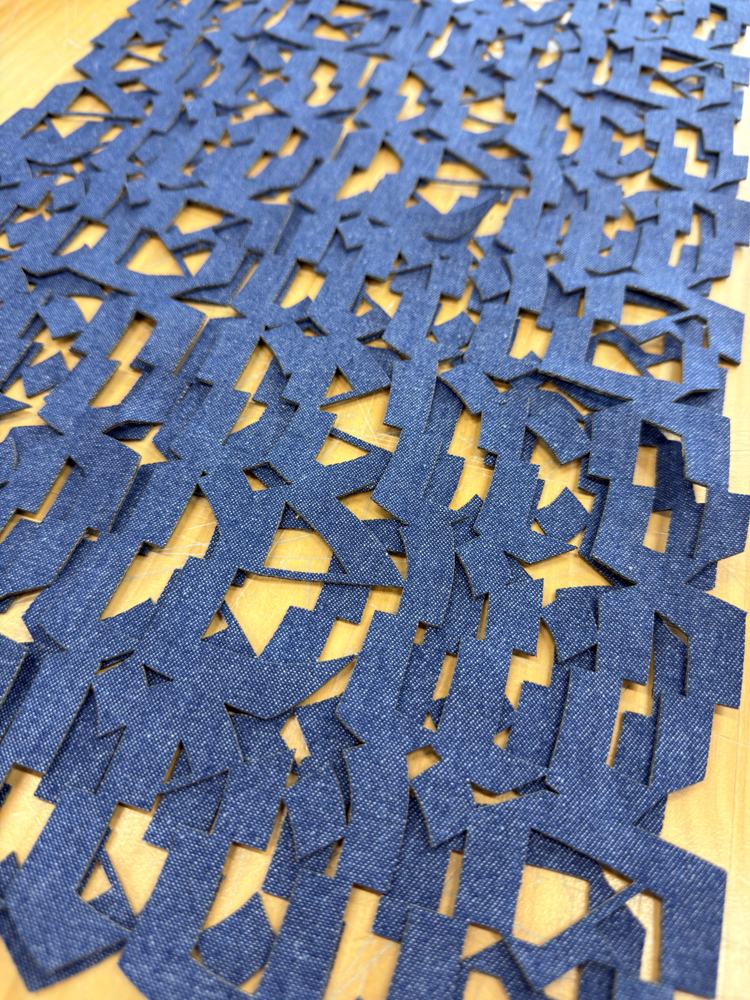
Every process was recorded in shared databases of materials and calligraphic styles, the starting point for the technical sheets of this second edition.
Participating institutions:
- Academy of Fine Arts and Design in Katowice (Poland)
- University of Nicosia (Cyprus)
- University of Art and Design of Cluj-Napoca (Romania)
- University of the National Education Commission, Kraków (Poland)
- University of Silesia in Katowice (Poland)
- Faculty of Commercial and Business Sciences, Celje (Slovenia)
- Hochschule Hannover (Germany)
ID BIP (2025–26): 2024-1-ES01-KA131-HED-000212470-1
CAFALAB 2.0 is co-funded by the Erasmus+ Programme of the European Union.
